

I have been thinking how best to approach a book about native swimming.
I think it should be an aquatic version of Cobbett’s Rural Rides, with a similarly discursive style. I would keep the itinerary as simple as possible, swimming or dipping as cheerfully as an otter in fresh or salt water …
I spent some hours in the Map Room at the University Library in Cambridge the other day, hoping for the same experience as John Cheever’s Neddy Merrill in ‘The Swimmer’: ‘He seemed to see, with a cartographer’s eye, that string of swimming pools, that quasi-subterranean stream that curved across the country.’
I concluded that although I could certainly swim across Sunningdale or the stockbroker pools of Leatherhead like that, or combine hiking and swimming across parts of Wales, the Lakes and Scotland, where you could more or less draw leylines through the blue marks on the map, most of Britain’s interesting swimming places are more haphazard in their distribution.
I think I should go by car, and my course should meander, like the Severn, with many a detour to visit this or that fen, village bathing hole, beach, waterfall, moat, burn, pool, creek, sandbar, cove, tarn, even the odd interesting swimming pool …
This would be, above all, a personal journey; a kind of quest for a remaining sense of a land and a people with a deep instinctive affinity for water …
I am not proposing an attempt on The Guinness Book of Records. Returning to Cheever’s swimmer, my impulse is essentially the same as his: ‘The day was beautiful, and it seemed to him that a long swim might enlarge and celebrate its beauty.’
As to a title, I’m sure it would come to light in the course of the work.
*
Is it surprising, based on this proposal, that Waterlog ever got published at all – let alone became the bestseller which helped reimagine our relationship with the natural world?
The project sounds unclear in Deakin’s mind, as though he came up with the idea ‘the other day’ after looking over some maps. The ‘discursive style’ suggests a ‘haphazard’ narrative ‘with many a detour’. Add to that Deakin’s confidence that a title would ‘come to light’ in the course of his work. And is there a contradiction, when, in the same sentence, Deakin describes the book as both a ‘personal journey’ but also an outward-bound ‘quest’ to discover a ‘land’ of water-lovers?
Fans of Waterlog will recognise Deakin’s characterful voice, his digressions and tendency to move between genres, such as travelogue, memoir, social history and nature writing. The ‘haphazard’ route also alludes to the awkward plot. When I meet Patrick Barkham for a swim near his home in Norfolk, even he admits, ‘I think Waterlog could do with an edit. It becomes repetitive; Roger just does too many swims’. So I want to understand how this potential disaster became the book we know and love. What are the secrets of his success?
Is it surprising, based on this proposal, that Waterlog ever got published at all – let alone became the bestseller which helped reimagine our relationship with the natural world?
Deakin grew up in Hatch End, a small suburb teetering between post-war London and the English countryside. His parents were lower-middle class, but he won a direct grant to a posh boys’ school before studying at Cambridge in the early 60s. Barkham suggests this ability to ‘cross boundaries’ and ‘resist categories’ became a defining feature of his life. Even swimming is envisioned at the start of Waterlog as a ‘crossing of boundaries’.
Deakin went on to have a shapeshifting career as an ad man, teacher, filmmaker and activist, and throughout his adult life, he continued to move between London and Walnut Tree Farm, his beloved home in Suffolk, as though reluctant, perhaps even unable, to commit to a single version of himself. ‘In the 70s,’ Barkham says, ‘he wrote in his notebooks about feeling lonely at Walnut Tree Farm. The reality is he went back to London all the time, and the journey wasn’t as long or slow as it would be for me and you, because he drove incredibly fast – 100mph on quiet country roads.’
 Roger Deakin takes a bath. Photo: The Roger Deakin Estate
Does this kind of eclectic and rebellious sensibility present problems for the biographer? Barkham began writing a ‘conventional’ biography and got 90,000 words down thanks to a writers’ retreat in Switzerland. But he worried the book didn’t properly reflect Deakin’s ‘fluid spirit’. ‘I wasn’t in crisis,’ he explains. ‘I felt so familiar with the material, as though I could see it from all angles, and felt now is the time to experiment.’ So he booked himself into the Shepherd’s Hut at Walnut Tree Farm (then an Airbnb) and ‘had a go at writing as Roger’.
Deakin was a compulsive diarist. His notebooks have been published as Notes from Walnut Tree Farm. There is also an archive of his writing at the University of East Anglia. But Barkham found even more material, a ‘treasure trove’, on an abandoned computer in the loft. He began to study these diaries and notebooks, learning how to write like Deakin before realising he could ‘let Roger tell his own story’ – using the first person to add context, link separate passages and write up the stories which Deakin’s friends had shared with him in the process of research. ‘If you’re reading a bit of Roger and there’s something slightly boring and factual, then it’s probably me,’ Barkham says. ‘Later on, when it comes to girlfriends, I couldn’t risk putting my voice into any of that, so I’m just quoting directly from his notebooks and letters.’
This eclectic and rebellious sensibility presents problems – or opportunities – for a biographer. Barkham began writing a ‘conventional’ account, but he worried the book didn’t properly reflect Deakin’s ‘fluid spirit’.
What is special about Deakin’s voice? Barkham points to his tendency to romanticise, idealise, even fantasise – an impulse at the heart of Waterlog. Listen to how he gets in the water: ‘I plunged’, ‘dived’, ‘leapt’, ‘threw myself in’, ‘I woke to the beginnings of a fine day and bathed in the lake’. There is no friction or resistance in his experience of water or the natural world. Yet Deakin was travelling back to Suffolk after each swim to look after his mum, Gwen, who was very ill and died while he was in Northumberland. He doesn’t let this reality alter the fantasy world of Waterlog, despite the ‘personal journey’ he promised in his proposal. Nevertheless, Barkham suggests you can ‘feel the melancholy’ in this part. Deakin stands in a phone box, sheltering from the rain, and describes a rainbow which appears above the ‘heavenly castle’: ‘It was absurdly magnificent and sad’.
Barkham believes Deakin’s voice is also full of ‘metaphoric dazzle’. Recall his famous ‘frog’s eye view’ of the world, mallards ‘wander[ing] the streets like sacred cattle in India’, and the moorhens which ‘walk like little girls at parties in their mothers’ high heels’. He links this talent for metaphor to Deakin’s love of nature. ‘To think metaphorically is to think ecologically,’ Barkham says, before pointing to another example where Deakin likens weeds at the bottom of a small river to the experience of flying over a rainforest. He connects big and small nature, he recognises the riverbed is a complex system, ‘a miniature world’ of equal value and fascination to the rainforest.
This need to romanticise and idealise seems at odds with the idea we have of Deakin as a man who made bold, perhaps even selfish decisions to live as he pleased, and suggests someone who felt isolated, frustrated, dissatisfied. Barkham points to a surprising absence in Deakin’s diaries and notebooks: ‘I’m lacking material on his relationship with his mum; he just doesn’t write about it anywhere’. Barkham describes this relationship as the ‘root of pain and sadness in Deakin’s life’ following the death of his dad in 1960. Deakin felt responsible for looking after his mum and ‘installed’ her in a cottage close to Walnut Tree Farm.
Barkham believes Deakin’s voice is also full of ‘metaphoric dazzle’. Recall his famous ‘frog’s eye view’ of the world, mallards ‘wander[ing] the streets like sacred cattle in India’, and the moorhens which ‘walk like little girls at parties in their mothers’ high heels’.
Perhaps as a result of his ability to cross boundaries and resist categories, Deakin struggled with intimate relationships which required long-term commitment. He never settled down with a life-long partner, and when I ask Barkham which chapter was the hardest to write, he doesn’t pause: Chapter 10, Deakin’s ‘abusive’ relationship with Serena Inskip, who lived at Walnut Tree Farm during the 80s. Barkham wrote this in collaboration with Inskip. ‘Serena wasn’t sure initially how much she wanted to say and so we were back and forth a lot,’ he says, ‘but she finally got to a point where she’d worked out what she wanted to say which is amazing because of how it fits in with Roger’s notebooks.’
Is this need for space and control relevant to Deakin’s love of nature and conservation? After all, as Barkham suggests, ‘it’s much easier to live with a toad on the threshold and swallows in the chimney than a long-term partner and kids’. But he’s keen to emphasise that this isn’t either/or: Deakin could be selfish and singleminded, while also extremely loyal to his friends and compassionate towards the natural creatures who lived alongside him at Walnut Tree Farm. You can see both sides of his personality when John Farley (a friend and neighbour) recalls Inskip ‘in pieces, anticipating Roger getting really angry because she’d lost a hedgehog he had kept in a box on the Aga and she knew this was really gonna be fireworks time’.
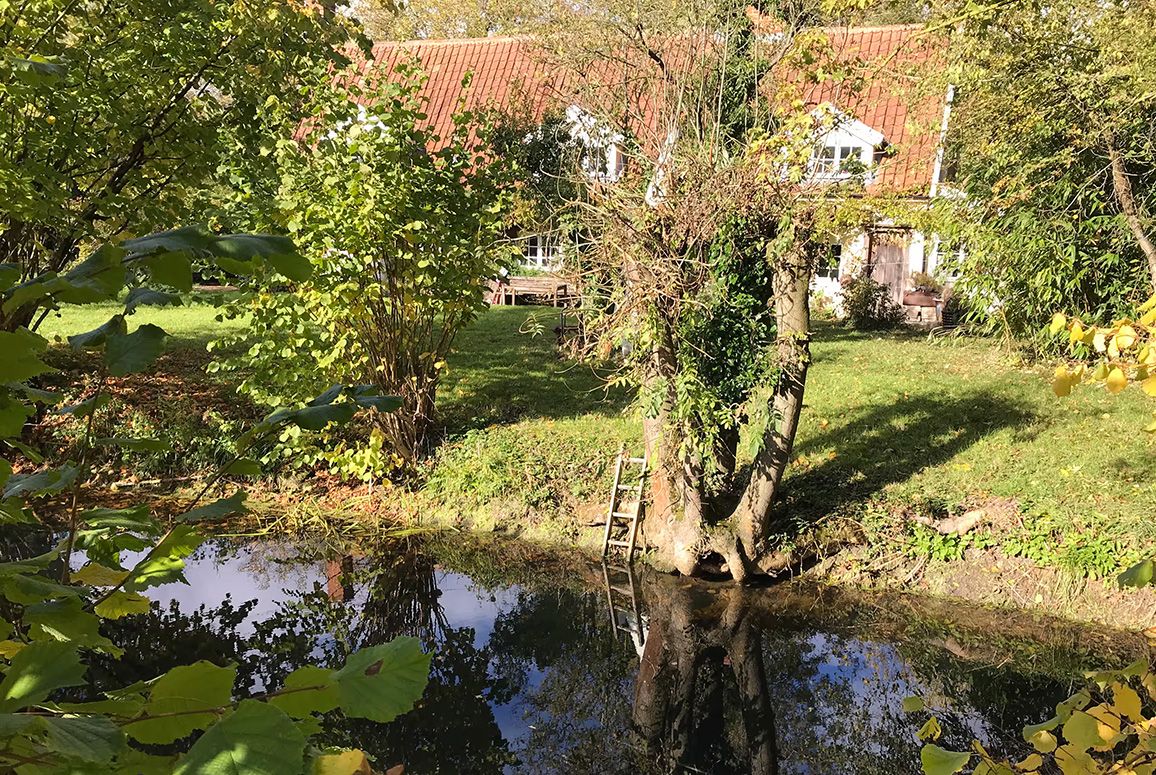 Walnut Tree Farm. Photo: Titus Rowlandson
So what about his legacy?
Barkham paraphrases Deakin when he writes that Waterlog ‘frog-kicked’ a revival in outdoor swimming. I try to pin down what this means – did Deakin simply have good timing or a more profound cultural impact?
Barkham suggests a ‘compelling story’ is essential for any widespread behavioural change, but he also points to the role of technology and media to make outdoor swimming accessible, from the introduction of neoprene wetsuits to The Outdoor Swimming Society. He suggests Deakin’s most important success was to ‘reimagine Britain for the purpose of swimming’ – to prioritise rivers, lakes and coastline as places where we have rights and responsibilities.
In 2006, at the age of 63, Deakin died. A brain tumour the size of an orange was found four months before his death but had already been affecting him, perhaps exacerbating the tortured process of his second book, Wildwood.
His sudden death means we can imagine Deakin still alive and active in the current political moment and Barkham is sure he’d want to play a leading role in organisations such as The Outdoor Swimming Society, Extinction Rebellion and Right to Roam: ‘I wanted to do something practical to stand up for nature in the face of the unprecedented onslaught of pollution and casual degradation of the world.’
There is no doubt Deakin would have loved the spotlight and the chance to do more radio, TV and festivals. Barkham laughs as we imagine Deakin becoming ‘a white-haired grandee’ of activist circles: ‘He would have been patron of this and ambassador for that. He would have helped get busloads of people down to XR protests.’ We can also be sure he would have championed these causes with the same charm, optimism and persuasive force which first captured our imaginations in Waterlog.