

She could have watched from afar – the videos, the photos, the stories of hundreds of swimmers drifting down a tidal river in Devon.
But that wasn’t enough.
In July 2023, Marie-Claire boarded a plane from Quebec to London, following a question she couldn’t answer from home. She came to swim the Bantham Swoosh to understand what kind of swimming this was – what it felt to share the joy of swimming with so many – hoping she could create the same kind of community at home.
Two years later, that journey rippled back across the Atlantic. In Quebec, a new generation of swimmers entered a river : – not to race, but to belong.
A few days after leaving Quebec, a province in eastern Canada, I was swimming in the River Avon, in the West Country of England, surrounded by hundreds of others. With every breath, my gaze shifted between the treetops, where egrets nested, and the clear, sandy riverbed below, where I had read I might glimpse crabs. The water was salty; everything felt unfamiliar. I could hardly believe I was finally there, after months of counting the days and training in a swimming pool all winter. I passed some swimmers, others overtook me. I no longer knew how many of us there were — wherever I looked, ahead or behind, I saw swimmers as far as I could see, beneath a darkening sky. As I swam, a question floated alongside me: would I go and introduce myself to the two women whose work had shaped this journey – Kate Rew and Kari Furre – or would the swim itself be enough?
I had crossed the Atlantic to experience something I longed to see exist at home: a swim where people gathered not to race, for medals or challenge rankings, but simply for the pure joy of swimming together.
Back home in Quebec, water is everywhere, but easy access for casual swimming is rare. We have vast, wide rivers, and thousands of lakes, many of them remote, frozen for half of the year, and the shorelines of waterways near population centres are often privately owned. Water feels serious: shaped by its’ vastness, generations of maritime stories, the size of the current, the intensity of our seasons. It is structured, not social – swimming outdoors is still mostly confined to triathlon, competition or sporting feats. Lakes are seen as race venues and training grounds. Shores as finish lines, and timing chips abound. Informal swimming exists, but not at scale. I wanted to help create the same sense of community, the same celebration of swimming for its own sake, as I saw in the UK.
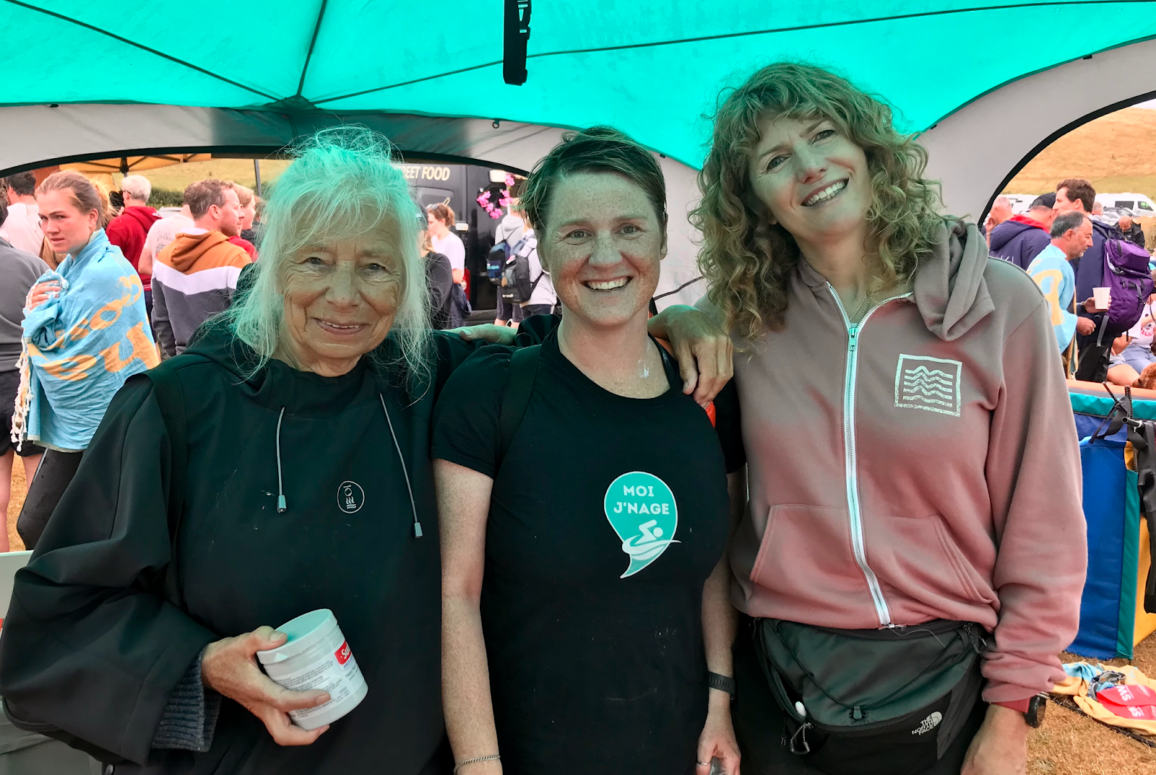
By the time I reached the end of my swim, the rain was pouring down. I climbed the sandy slope back to the finish tents along with the other swimmers and stood in the changing area, still unsure whether I would meet the women who had inspired me so deeply that I had come here. Then someone behind me started gently applying cream to my neck where my wetsuit had rubbed it raw. I turned around, and there stood Kari Furre.
I could hardly believe it. ‘A change of technique could help with the chaffing,’ she was saying, ‘but the ointment should soothe it for the moment’. All I managed to say was, “It’s you… it’s really you…”
I told her I had crossed the ocean to swim and to meet her, and she smiled and took my hand, and led me straight to Kate.
The rest is a beautiful blur. Yes, I probably looked like a groupie. But I also absorbed something vital from that encounter: a spark, energy, courage. When I left, this was the feeling that I carried with me – and relied on – as I worked to bring that same spirit home
BRINGING IT HOME
That was July 2023. Two years later, on July 6th 2025, the idea was realised in the water.
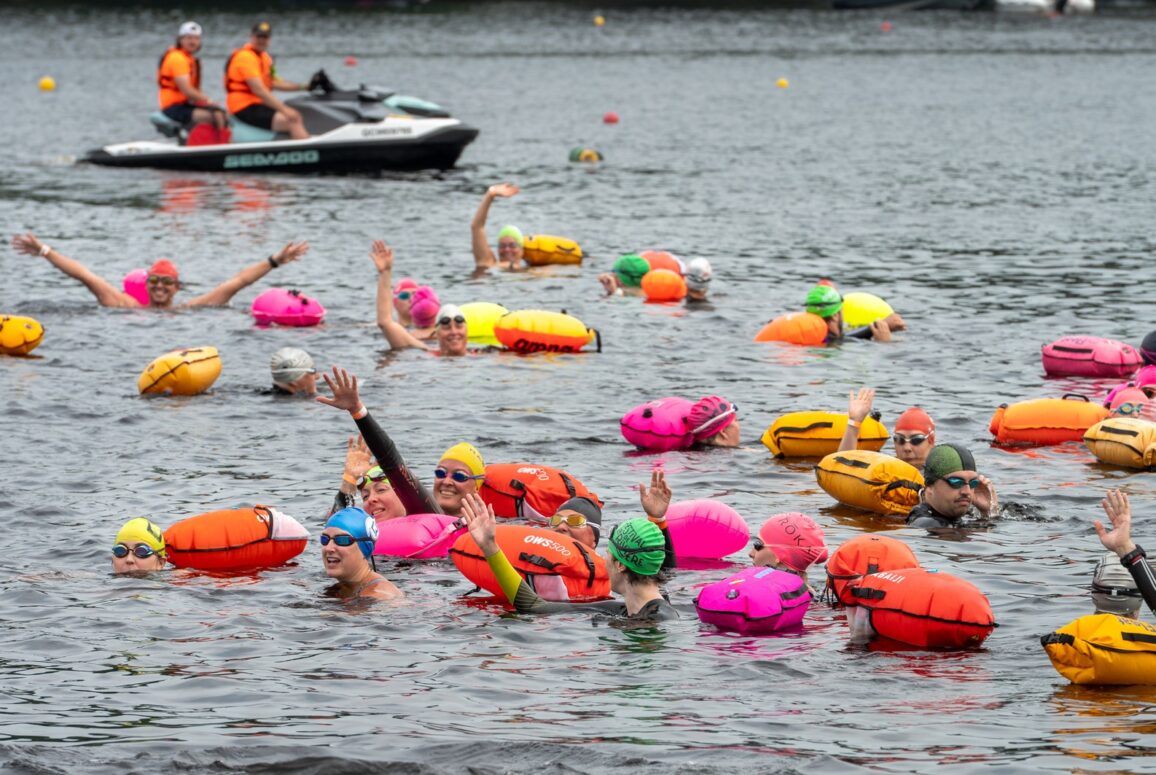
Early that morning, I watched seventy-five swimmers board yellow school buses and make their way to the Saint-Maurice River, preparing to swim 1.5km or 3 kilometres downstream. Right up until the morning of the swim, the route had to be revised. It is a powerful river, controlled upstream by dams. In Quebec, many rivers have been harnessed to produce electricity. To swim it was also to listen to it — and to let it dictate the safest path. There were no timings, no ranking – just people entering the river together. What struck me most was the diversity: all ages, shapes and experience levels. What united us was the simple joy of swimming, without pressure, in a kind and non-competitive environment where everyone naturally found their place. It was a celebration of water, of community, of the simple joy of swimming.
As bright hats and towfloats moved steadily down the Saint-Maurice, I thought of what used to travel this water. Not swimmers – logs. For decades, our rivers, particularly this one, until 1995 — were treated as industrial corridors: too polluted, too dangerous, simply unthinkable for swimming.
But my dream had happened: an open-water swim in Quebec, centred entirely on participation and shared experience, rather than competition.

 Pixel et Grafik
MOVING ON
Among the participants, two women approached me, hoping to recreate this type of event in their own region.
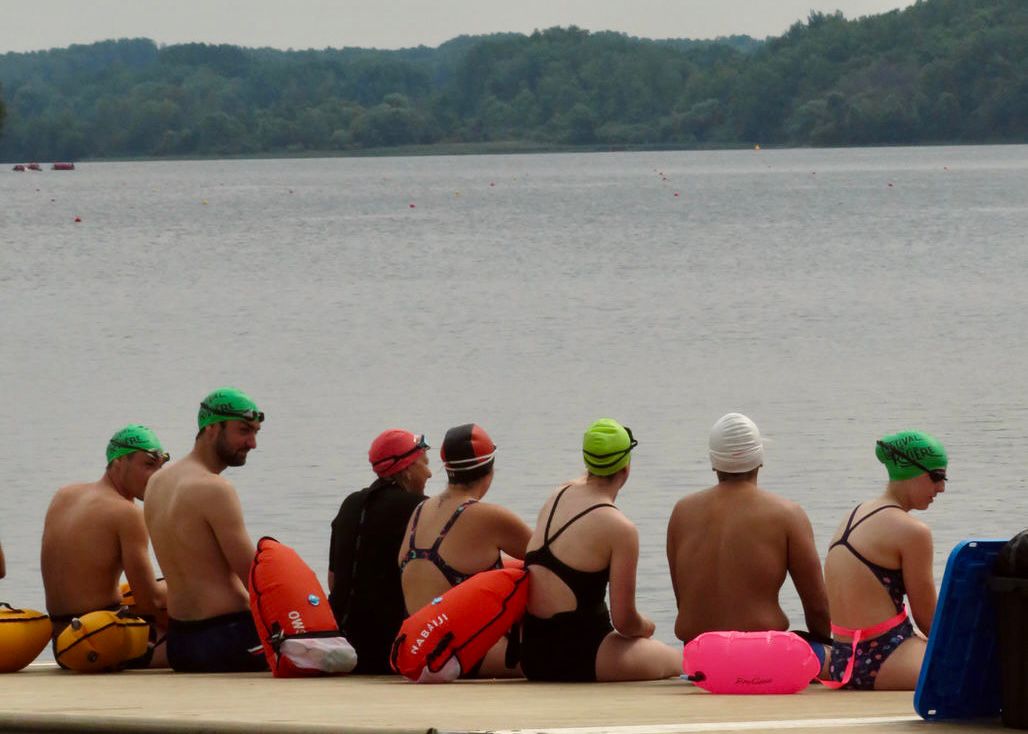
Two months later, in September, another recreational swim took place – this time, a lake crossing. In Quebec most people stop swimming by the end of August, as the water cools quickly and the season is considered over. So considering that many swimmers didn’t have wetsuits, we were surprised to welcome forty-five people.
These numbers may seem modest, but something had shifted.
For the first time, I felt that what had begun as a solitary journey – crossing an ocean to bring an idea home – no longer belonged to me alone. The idea was moving on, carried by others, one swim at a time.
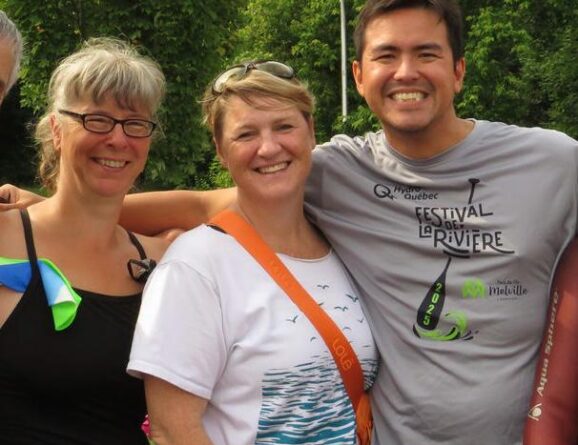
Marie-Claire Fortin has since founded an outdoor swimming organisation in Quebec: Nage en eau libre Québec: Moi j’nage. Find her on instagram: @nage_en_eau_libre